
Training load
Why can a small-sided game feel so demanding when the distance is low?
A smaller space limits high-speed running, but it can create more frequent starts, stops, turns, duels and decisions under pressure.
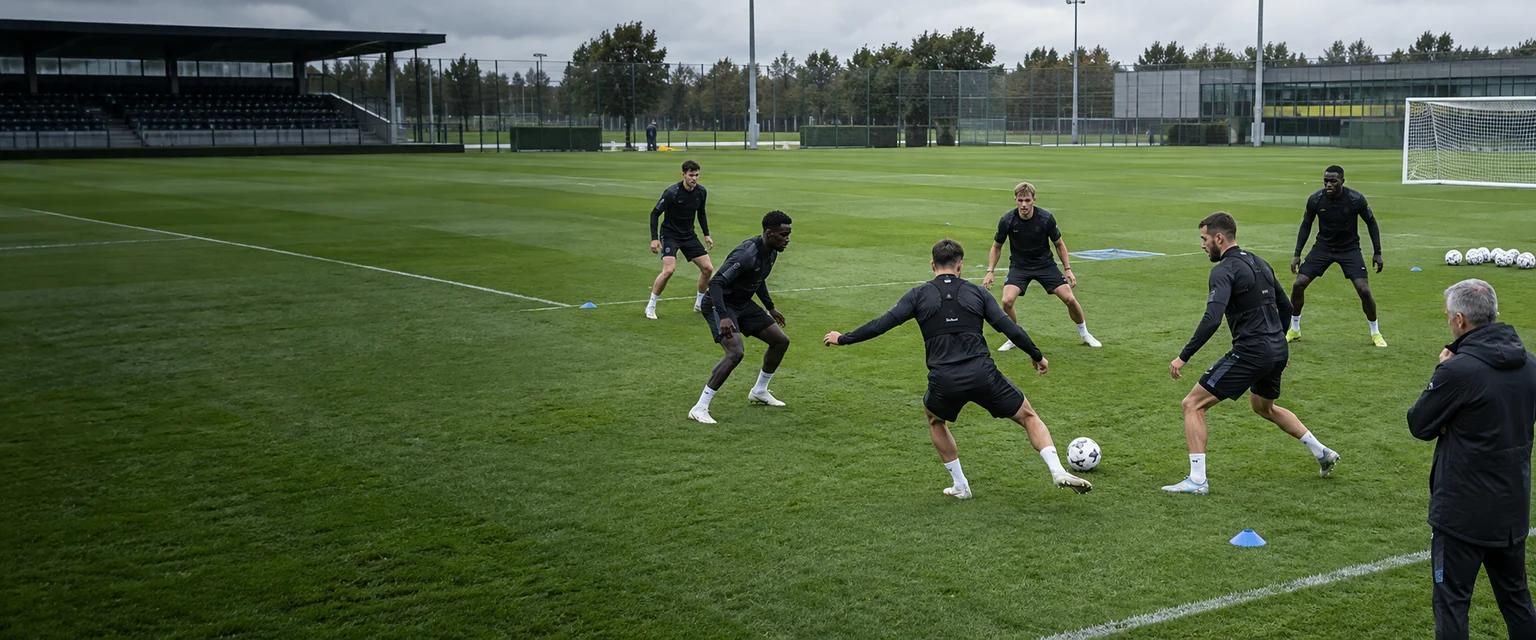
Total distance answers only one question.
Small-sided games are often short, interrupted or played in a compact area. Players may repeatedly move a few metres to press, support, receive, turn and recover without accumulating the long continuous runs seen in larger formats.
Total distance describes volume. It cannot, by itself, describe movement density, cardiovascular response, repeated changes of direction or the tactical demand of the task.
Available area changes the movement profile.
The useful field-size measure is the area available per player, not simply the pitch length. Increasing relative area generally creates more opportunity for longer and faster running. Reducing it can increase close pressure, transitions and repeated mechanical actions.
Rules matter too. Touch limits, neutral players, goalkeepers, scoring conditions and coach restarts can change the same numbered game into a different physical and tactical task.
Write down the intervals and substitutions.
Record the start and end of each block, the players involved, substitutions, rest and rule changes. Otherwise a full-session total may compare one player who completed every block with another who rotated out.
Review effective duration, distance per minute, speed zones, accelerations and decelerations, configured heart-rate data and the session objective together. No single column represents the whole stimulus.
Compare like with like before looking for trends.
Keep format, relative area, work-to-rest structure and counting rules stable when comparing the same drill over time. If the task changes, interpret the new values as a different stimulus rather than a simple improvement or decline.
ATHLOS keeps the selected session period, player participation and report outputs connected, helping staff return from the chart to what actually happened on the pitch.
Review a session with ATHLOS